https://www.wedtry.com/the-evolution-of-the-solar-system-from-planetary-rings-to-the-secrets-of-ceres-and-mars-moons/
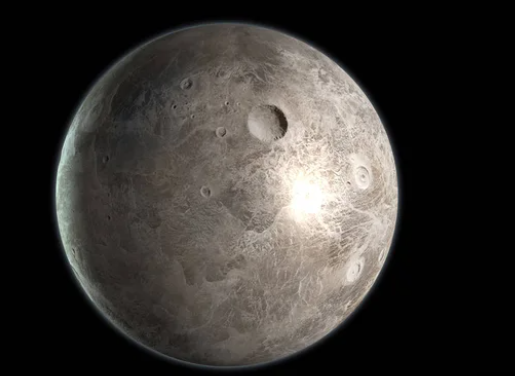
Ceres is the largest asteroid in the solar system, located in the asteroid belt between the orbits of Mars and Jupiter. Although it can’t compare to the big planets, Ceres has many special geological features and unique stories that reveal secrets about the early formation of our solar system.
This article will take you deep into understanding Ceres’ origins and how it transformed from cosmic dust into an important small world within the solar system.
一、The Birth of the Solar System and the Formation Background of Ceres
About 4.6 billion years ago, the solar system was just a huge cloud of gas and dust known as the primordial nebula. Under gravity, this material began to gather, forming the early Sun and a surrounding disk-shaped structure called the protoplanetary disk. In this disk, dust particles gradually clumped together, forming small rocks and planetesimals.
Ceres was born in the asteroid belt region within this disk. This region has relatively sparse material and is farther from the Sun, making the environment colder. Compared to regions closer to the Sun, the materials here move more slowly, so when planetesimals collide, they tend to stick together and grow larger. Ceres formed slowly through countless collisions and agglomerations of these small particles and fragments.
二、From Dust Particles to Dwarf Planet: The Growth Process of Ceres
Ceres did not form overnight; it underwent a long period of accumulation and change. At first, tiny dust and ice grains collided repeatedly under the Sun’s gravity, gradually forming primordial bodies a few kilometers in size. Over time, these bodies attracted each other, collided, and merged, growing larger and larger.
During this process, Ceres’ mass increased, and its gravity grew stronger, enabling it to attract more dust and gases. It gradually evolved from a simple mixture of rock and ice into a dwarf planet with a complex internal structure. Scientists speculate that Ceres may have a rocky core surrounded by a thick layer of ice, and possibly even an underground ocean of liquid water. This hypothesis is based on discoveries of surface water ice, organic compounds, and signs of surface activity.
三、Geological Features Reveal Ceres’ History
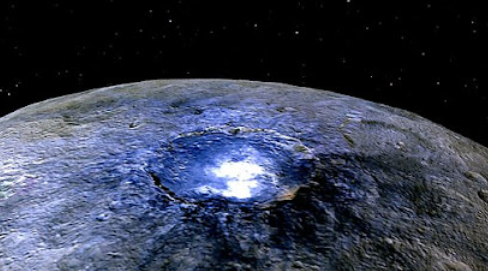
Close-up observations by spacecraft, especially NASA’s Dawn mission, have allowed scientists to glimpse the rich geological history of this dwarf planet.
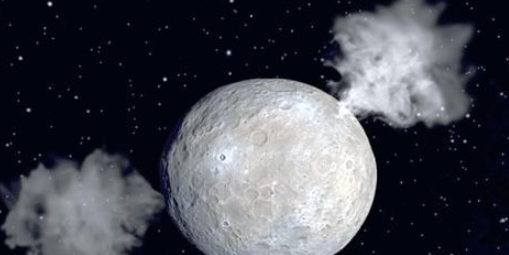
Ceres’ surface is covered with impact craters, showing its long history of collisions. It also has features similar to cryovolcanoes, indicating that internal heat and material movement have not ceased, and that geological activity may still be ongoing. This “active” status is an important clue to understanding Ceres’ origin and evolution.
These findings support the idea that after its early formation, Ceres was not completely “dead” but experienced internal layering, thermo-chemical reactions, and even liquid water activity, shaping its unique geological landscape.
四、Ceres’ Connection with Other Solar System Bodies
As the largest body in the asteroid belt, Ceres’ origin and evolution help scientists understand the history of other regions in the solar system. Situated between Mars and Jupiter, it lies at the core of the asteroid belt, and the composition and features of other small bodies in this region are closely related to Ceres’ formation.
Moreover, Ceres contains abundant water ice and organic materials, which are significant for studying the origin of Earth’s water and the conditions for life. Scientists are exploring whether Earth’s water and organic compounds may have partly come from impacts and delivery by small bodies like Ceres.
五、Future Exploration and Expectations
With advancing technology, future explorations of Ceres will become more detailed. Scientists look forward to missions that can unveil the secrets inside Ceres, confirm the presence of its subsurface ocean, and further reveal its origin and evolutionary history. Ceres is also considered an important target in the search for signs of life in the solar system.
Exploring Ceres is not just about understanding an isolated dwarf planet but is a crucial step in unraveling the history of the solar system and the origins of life.
- Summary
Ceres, formed slowly from cosmic dust and ice grains, holds many secrets of the early solar system. Its formation illustrates universal laws of nebular collapse and small body collisions and mergers; its complex geology reveals the vitality and potential of dwarf planets. Through ongoing exploration, our understanding of Ceres not only enriches knowledge about the solar system but also promotes human contemplation of the universe’s origin and the possibility of life.
In the future, with more missions underway, Ceres will continue to act as a bridge between the past and the future, leading us to uncover deeper cosmic mysteries.
https://www.wedtry.com/the-evolution-of-the-solar-system-from-planetary-rings-to-the-secrets-of-ceres-and-mars-moons/