https://www.wedtry.com/the-cosmic-dance-a-complete-guide-to-orbits-and-gravity/
If you look up at the night sky, you’ll see tiny specks of light and, occasionally, a bright “planet.” These planets, seemingly scattered randomly across the sky, actually have a delicate dance behind them. They orbit the sun like a grand cosmic waltz.
Today, let’s discuss why planets don’t fly away or fall into the sun. How are their orbits maintained? The secrets behind this are gravity and orbital mechanics .
The Solar System’s Dance Floor: Gravity’s Invisible Web
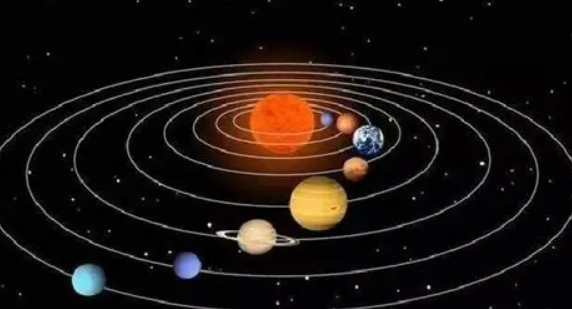
The core of the solar system is the Sun, which accounts for over 99% of the system’s mass. What does mass mean? It means its immense gravitational pull . You can imagine the Sun as the center of a dance floor, with the planets as its dancing partners, held together by invisible threads.
This “thread” is gravity. It keeps the planets from flying away into space, yet at the same time prevents them from being sucked directly into the Sun. Under this force, the planets maintain a delicate balance: gravity pulls inward, while the planets’ inertia throws them outward . These two forces cancel each other out, forming their orbits.
Why an ellipse and not a circle?
When many children drew the solar system, they often depicted the planetary orbits as circles. In reality, the true orbits are more like ellipses . This discovery is thanks to the 17th-century astronomer Kepler.
By observing the motion of Mars, Kepler discovered that planets do not orbit perfectly circular paths, but rather ellipses , with the Sun at one focus of the ellipse. This means that a planet is sometimes closer to the Sun (at perihelion ) and sometimes farther away (at aphelion).
This explains why Earth is hotter at certain times of the year and colder at other times. While the main cause of the seasons is the tilt of the Earth’s axis, the shape of its orbit also has a subtle effect.
Rhythm Sense: The Secret of Orbital Cycles
Since it’s a waltz, it must have a rhythm. The rhythm of the planets is their orbital period .
Kepler’s third law tells us that the farther a planet is from the sun, the longer it takes to orbit it.
Mercury takes only 88 days to orbit the sun, so it rotates very fast.
The Earth takes 365 days.
Pluto (although it has been “demoted”, it is still a member of the solar system family) takes 248 years to orbit the sun.
It’s like a dance floor where some dancers twirl lightly in the center while others glide slowly around the edges, each keeping their own rhythm while all following the same movement.

Resonance: the tacit understanding between dance steps
At a dance party, some partners always have a perfect rapport with each other. The same is true for planets, whose orbits sometimes experience what are called orbital resonances .
For example, Jupiter’s moons, Io, Europa, and Ganymede, have a 1:2:4 resonance relationship. This means that for every two revolutions of Io, Europa completes one, and for every one revolution of Ganymede, Io completes four.
In the solar system, there is also resonance between the asteroid belt and Jupiter. This invisible “rhythm” allows planets and celestial bodies to remain stable for a long time and not easily collide with each other.
Gravity Assist: Can dance steps be accelerated?
In addition to the planets’ own “dance steps”, human spacecraft have also learned to dance with the help of force. You may have heard the term “gravitational slingshot” or “gravity assist”.
Simply put, when a spacecraft approaches a planet, it cleverly uses the planet’s gravity to “accelerate” or “turn” its speed. This is like at a dance party, when your dance partner pulls you, you instantly spin faster.
This is how probes like Voyager and New Horizons are able to fly to the farther edges of the solar system. Otherwise, it would be impossible to fly that far relying solely on rocket fuel.
What would happen if there was no gravity?
Imagine an extreme situation: What would happen if the sun’s gravity suddenly disappeared?
The answer is this: like dancers suddenly losing their partner’s pull, the planets would instantly fly off into the depths of space, tangent to their original orbits, and drift infinitely farther. The solar system’s dance would disintegrate in an instant.
This makes us more aware that although gravity is invisible, it is the fundamental reason why the solar system can coexist harmoniously.
Our Earth Dance
Having said all that, let’s return to our primary concern, the Earth. The Earth’s orbit and rotational rhythm determine our cycle of day and night and the seasons. It’s fair to say that without this orbital dance, we wouldn’t have the life we have today.
Moreover, scientists speculate that if the Earth’s orbit deviated too much, for example, became too elliptical, then the climate on Earth would be extremely unstable and life might not have been able to survive to this day.
Summary : Cosmic Dance
The solar system is a vast dance floor, with the sun as the lead dancer and the planets as its partners. Each planet has its own rhythm and steps, but they all follow the same “music of gravity.”
This dance has been going on for 4.5 billion years and will continue until the Sun grows old.
The next time you look up at the starry sky, imagine that those tiny points of light are participating in this magnificent and romantic cosmic waltz just like us.
https://www.wedtry.com/the-cosmic-dance-a-complete-guide-to-orbits-and-gravity/