https://www.wedtry.com/a-complete-guide-to-the-planets-of-our-solar-system/
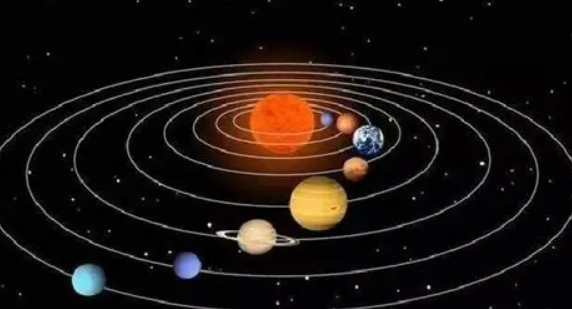
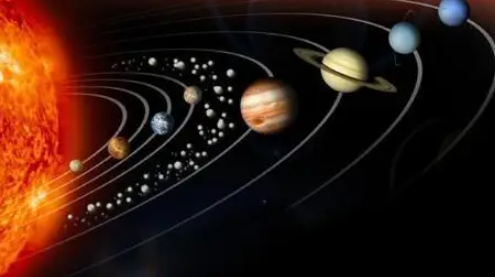
When you think of the solar system, the first thing that comes to mind is the “eight planets.” Well-known planets like Mercury, Venus, Mars, and Earth have been explored by spacecraft and frequently appear in the news. But what you may not know is that there are two easily overlooked giants at the edge of the solar system: Uranus and Neptune, known as “ice giants.”
Strangely, despite their size, both planets are over four times the diameter of Earth, yet scientists call them “blind spots” in the solar system. Why? Today, let’s discuss this unpopular yet fascinating topic.
What is an “ice giant”?
There is a special type of member in the planet family: ice giants.
Unlike gas giants like Jupiter and Saturn, Uranus and Neptune are composed not only of hydrogen and helium but also of large amounts of “ice.” Don’t get me wrong, the “ice” we’re talking about here isn’t frozen water, but rather the astronomical equivalent of “ice”—a category that includes substances like water, ammonia, and methane that are solid or liquid at low temperatures.
The reason these planets appear blue is because their atmospheres contain methane, which absorbs red light and reflects blue light.
Simply put: Jupiter and Saturn are “fat gas guys”, and Uranus and Neptune are “blue fat ice guys”.
Why are they called “blind spots”?
1. The absence of detectors
To date, the only human probe to have truly visited these two planets up close is Voyager 2. That flyby, back in the 1980s, lasted only a few days, but the photos and data it captured remain our most important firsthand data.
By comparison, Jupiter has Juno, Saturn has Cassini, and even Mercury and Pluto have received dedicated missions. Uranus and Neptune are like forgotten children in a corner.
2. Difficulty in observation
They are so far away, billions of kilometers from Earth, that looking at them through a telescope is like staring at a fuzzy dot.
There are no obvious “landmarks” on the surface, unlike Jupiter with its Great Red Spot or Saturn with its rings, and the ice giants appear monotonous.
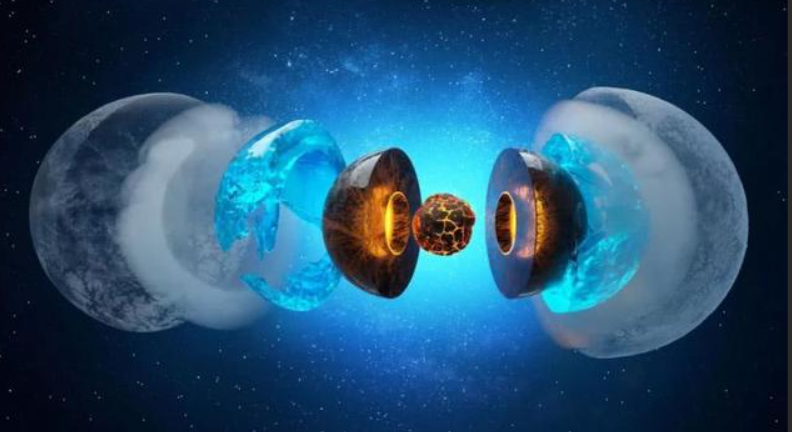
Their thick atmospheres and complex cloud layers make it difficult for scientists to directly see their internal structures.
3. Inadequate theoretical models
While scientists have accumulated extensive experience studying gas giants, ice giants appear to be a completely different type of planet. Their cores, internal structures, magnetic fields, and even weather systems differ from those of Jupiter and Saturn. For example, Uranus’s axis of rotation is almost flat, while Neptune experiences supersonic storms. These factors often conflict with existing theories.
Therefore, Uranus and Neptune have become “important yet unfamiliar” objects in solar system research, the so-called “blind spots.”

Mysterious features of ice giants
1. Uranus’s “sideways rotation”
Most planets have their rotation axes tilted at an angle to their orbits, but Uranus lies horizontally in its orbit, with its axis tilted nearly 98 degrees, like a ball rolling sideways around the sun. Scientists speculate that a massive ancient collision may have altered its position.
2. Neptune’s “Superstorm”
Despite its distance from the sun, Neptune boasts the strongest winds in the solar system, reaching 2,000 kilometers per hour! This is dozens of times stronger than a hurricane. Why such powerful energy can exist in such a cold, sun-deficient place remains a mystery.
3. Strange magnetic field
The magnetic fields of ice giants are highly irregular. Unlike Earth’s magnetic field, which is roughly aligned with its rotational axis, the magnetic axes of Uranus and Neptune deviate dramatically, even becoming “crooked.” This leads scientists to believe that their internal structures and distribution of conductive fluids may be completely different from those of other planets.
Why are scientists rushing to study ice giants?
Key clues to planet formation:
Ice giants have a unique compositional ratio that may be closely related to the distribution of matter during the formation of the early solar system. Studying them is like opening a “hidden chapter” in the history of the solar system.
Among exoplanet
discoveries, many “ice giant” planets, similar to Uranus and Neptune, are very common. Understanding these two “blue giants” can help us understand the thousands of similar planets in the universe.
While life is unlikely to exist on the surfaces of Uranus and Neptune, their moons (such as Uranus’s Miranda and Neptune’s Triton) may harbor subsurface oceans that could support life. Future exploration efforts will likely focus on these moons .
Future exploration plans
Scientists have long been aware of this “blind spot” problem, so international discussions have begun on new tasks:
NASA once proposed the “Uranus Orbiter” , planning to have a probe fly around Uranus to observe its atmosphere, magnetic field and satellites for a long time.
The European Space Agency (ESA) is also considering a joint project, hoping to send a probe to the ice giant in the 2030s or 2040s.
Some scholars even proposed “ice giants first”, believing that after completing the Mars mission, mankind’s next major goal should be Uranus and Neptune.
Summarize
Scientists call ice giants the “blind spot” of the solar system, not because they are unimportant, but because we are so unfamiliar with them:
There is a lack of data (Voyager 2, which was launched decades ago, is still “holding the scene” today).
Difficult to observe (too far away, monotonous appearance, complex interior).
The theory is insufficient (weather, magnetic field, and rotation are difficult to explain).
But precisely because of their mystery, the value of studying ice giants is even more prominent. Once new exploration missions are launched in the future, they may overturn our understanding of planetary science and even rewrite the story of the origin of the solar system.
So, next time you mention the eight planets in our solar system, don’t forget these two lesser-known but important figures. Perhaps the true secret lies somewhere in this blue, icy distance.
https://www.wedtry.com/a-complete-guide-to-the-planets-of-our-solar-system/