https://www.wedtry.com/a-complete-guide-to-the-planets-of-our-solar-system/
Uranus, the seventh planet from the solar system, has long been called the “strangest planet” by astronomers because of its unique axial tilt and icy blue-green appearance. In recent years, with the help of NASA’s Hubble Space Telescope and the latest James Webb Space Telescope, scientists have gained a deeper understanding of Uranus’ appearance, atmosphere, and climate system. This article will take you to explore the mysteries of this “ice giant” and introduce the latest findings of the American research team.

1. The strange appearance of Uranus: a blue-green “ice ball”
The most notable feature of Uranus is its pale blue-green appearance, which comes from the rich methane gas in its atmosphere. Methane absorbs red light and reflects blue-green light, giving Uranus a unique cool color.
NASA’s observation data: According to observations from the Hubble Telescope, Uranus’ atmosphere is mainly composed of hydrogen, helium and a small amount of methane. Methane clouds are formed under high pressure, shaping its hazy appearance.
Seasonal changes: Because Uranus’s axis of rotation is tilted by about 98 degrees, its poles continuously face the Sun during a 21-year season, causing extreme climate changes.

2. Extreme weather and storm systems
Although Uranus appears calm, NASA observations reveal the presence of violent storms and vortices in its atmosphere:
Hubble’s Discovery: In 2014, Hubble captured a huge white storm in the north pole of Uranus, covering an area equivalent to the continents on Earth.
New perspective from JWST: Infrared imaging from the James Webb Telescope in 2023 revealed a complex cloud structure at Uranus’ south pole that scientists believe is associated with methane ice crystals and deep atmospheric heating.

3. Uranus’s ring system and satellites
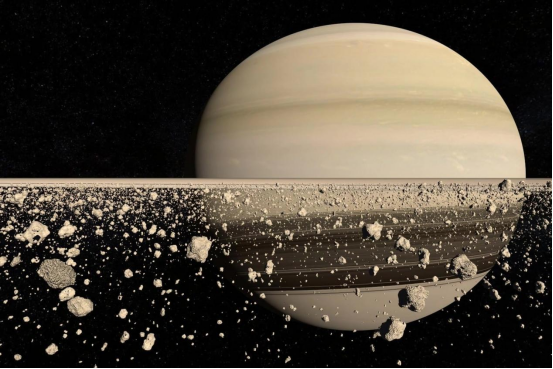
Uranus has 13 faint planetary rings and 27 known satellites, the largest of which are Titania and Oberon.
Contribution of Voyager 2: In 1986, NASA’s Voyager 2 flew past Uranus and took the first close-up photos of its ring system and satellites, discovering that the rings are composed of ice and dark matter.
Future missions: Scientists at Caltech and the Jet Propulsion Laboratory are proposing to launch a Uranus Orbiter to study its interior in depth.
4. Why is Uranus so important?
As an “ice giant”, Uranus is different from gas giants and may have a high-pressure icy substance rich in water, ammonia and methane in its interior. Studying Uranus will help:
Understand the early evolution of the solar system; reveal the formation mechanism of extrasolar ice giants; explore planetary physics phenomena under extreme climates.

From Voyager 2’s first visit to JWST’s cutting-edge observations, U.S. astronomical research institutions continue to promote the exploration of Uranus. This mysterious ice giant is not only an “alternative” in the solar system, but also the key to human understanding of planetary diversity. In the future, with the launch of more exploration missions, the veil of Uranus will eventually be completely unveiled.
https://www.wedtry.com/a-complete-guide-to-the-planets-of-our-solar-system/