https://www.wedtry.com/cosmic-debris-a-guide-to-meteorites-hygiea-comets/
When a bright streak crosses the night sky, many people look up in awe at this mysterious celestial phenomenon — a comet. Comets are among the oldest bodies in the solar system. Like cosmic time messengers, they carry secrets from the very birth of the solar system, slowly traveling from the distant reaches of space and bringing spectacular and mysterious sights.
This article will take you deep into the origins, structure, and trajectories of comets, as well as their significance in the universe and human history.
1. The Origin of Comets: Ancient Relics of the Solar System
Comets were born at the very beginning of the solar system’s formation, about 4.6 billion years ago. They mainly originate from two cold, distant regions at the outer edges of the solar system — the Kuiper Belt and the Oort Cloud. The Kuiper Belt lies beyond Neptune’s orbit and contains many icy small bodies; the Oort Cloud is even farther, forming a spherical “reservoir” of icy bodies thousands of astronomical units from the Sun.
Comets are part of these icy bodies, primarily made of ice, water, carbon dioxide, methane, ammonia, and dust. They are considered the most primitive relics of the solar system and preserve the material composition from that time. Studying comets helps us reveal the birth and evolution of the solar system.
2. The Structure of Comets: A Marvelous Mix of Ice and Dust
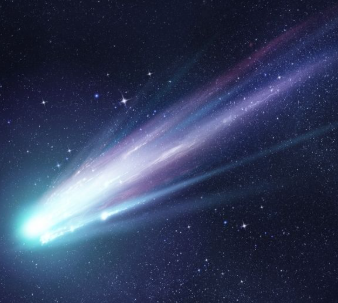
A typical comet consists of three parts: the nucleus, the coma, and the tail. The nucleus is a solid, frozen rocky body, usually only a few kilometers across. It’s like a “dirty snowball,” containing a mixture of ice and dust inside.
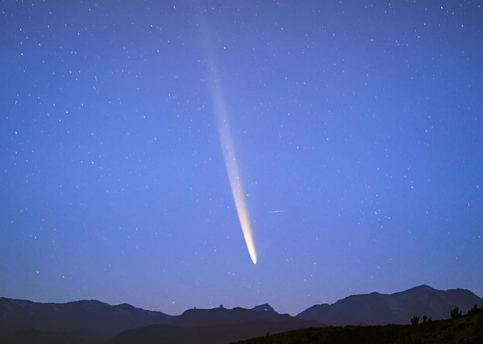
As a comet approaches the Sun, solar heat causes the ice in the nucleus to sublimate, releasing gas and dust and forming a thin cloud called the coma around the nucleus. The solar wind pushes this coma backward, creating two magnificent tails: an ion tail made of charged particles and a dust tail made of dust particles. The ion tail is usually blue and points directly away from the Sun, while the dust tail tends to be yellowish and more curved.
3. Magnificent Paths: Travelers Through the Cosmos
Comet orbits are usually very elongated ellipses; some resemble parabolas or hyperbolas, meaning they come from very distant regions near the Sun and then travel back into deep space. Their orbital periods around the Sun can range from a few years to tens of thousands of years.
When a comet nears the Sun, the sublimation of ice causes it to release material rapidly, forming a bright coma and tail, making it one of the brightest objects in the sky. Famous comets like Halley’s Comet return roughly every 75 years, bringing rare and spectacular astronomical events to humanity.
4. Comets in Human Culture
Since ancient times, comets have been viewed as mysterious celestial phenomena by humans. Ancient civilizations often regarded them as omens of good or bad fortune or signs from the gods. Historical records from ancient China and Europe document social upheavals and major events coinciding with comet appearances.
With scientific progress, humanity has gradually uncovered the true nature of comets, but they still inspire curiosity and awe. Modern astronomers study comets through telescopes and spacecraft; missions like ESA’s Rosetta probe have conducted close-up investigations, providing valuable data about cometary physical properties and chemical composition.
5. Possible Links Between Comets and the Origin of Life
Scientists believe comets may have been important sources of water and organic molecules on early Earth. During Earth’s early formation, extremely high temperatures made it difficult to retain water and complex molecules on the surface. Many comet impacts might have delivered water and organic compounds, effectively “seeding” Earth with the ingredients for life.
Studying comets not only helps us understand the origin of life on Earth but also offers clues in the search for life elsewhere in the universe.
6. Future Exploration: Unveiling More Secrets of Comets
With advances in space technology, future comet exploration will be more thorough. Scientists plan to launch more specialized spacecraft to study comets and even attempt sample return missions to analyze comet material more comprehensively on Earth.
These studies will further help us unveil the mysteries of the early solar system and pave the way for future resource utilization and interstellar travel.

Conclusion
Comets — these icy messengers from the depths of the cosmos — not only bring magnificent spectacles to our night sky but also serve as living fossils of solar system history. They have witnessed the collapse of the primordial nebula, the birth of planets, and may even carry the seeds of life. Through continuous exploration, we can better understand the universe’s past and envision humanity’s future. Every time a comet streaks across the sky, it’s like a magnificent cosmic epic unfolding before our eyes.
https://www.wedtry.com/cosmic-debris-a-guide-to-meteorites-hygiea-comets/