https://www.wedtry.com/the-evolution-of-the-solar-system-from-planetary-rings-to-the-secrets-of-ceres-and-mars-moons/
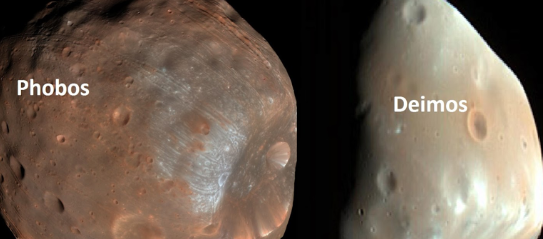
When we hear the word “moon,” most of us immediately think of Earth’s Moon—big, bright, and round, dominating our night sky. But did you know Mars also has moons? And not just one, but two! Meet Phobos and Deimos—Mars’s two tiny, oddly shaped satellites. Unlike our Moon, these little guys are so small and lumpy they look more like “space potatoes” than perfect spheres. So, why does Mars have these two tiny moons, and where did they come from? Their story is far more fascinating than you might expect!
Just How Small Are Phobos and Deimos?
If you’re imagining something like our Moon, think again—these Martian moons are tiny.
Phobos: about 22 km (14 miles) across.
Deimos: even smaller, at just 12 km (7.5 miles) wide.
To put it in perspective, they’re so small they wouldn’t even wrap around Beijing’s Third Ring Road! From Mars’s surface, they’d look like small dots in the sky, not glowing disks. Fun fact: Phobos orbits so close to Mars that it zips across the Martian sky every 4 hours and 15 minutes—faster than sunrise and sunset!
Where Did They Come From? Two Main Theories
Scientists aren’t 100% sure how Phobos and Deimos formed, but two leading theories dominate:
- Asteroid Capture Theory
This idea suggests Phobos and Deimos were once asteroids roaming the solar system. Mars’s gravity “snagged” them during the chaotic early days of the solar system. Their weird, potato-like shapes support this theory because asteroids are rarely spherical. - Giant Impact Theory
Another theory says they were born from a catastrophic collision. Billions of years ago, a massive object slammed into Mars, flinging debris into space. Over time, these fragments clumped together, forming Phobos and Deimos. This is similar to how many scientists think Earth’s Moon formed after a collision with a planet-sized object called Theia.
Neither theory is confirmed yet, but both paint a vivid picture of Mars’s dramatic past.
Phobos: The “Doomed” Moon Getting Closer
Phobos might be Mars’s larger moon, but its future looks grim. Scientists have discovered that Phobos is spiraling inward toward Mars at about 1.8 meters per century. That may not sound like much, but in astronomical terms, it’s a rapid death dive.
In 50 million years or so, Phobos will either:
Smash into Mars, or
Get torn apart by Mars’s gravity, forming a stunning ring system—turning Mars into a “red Saturn.”
Just imagine that: a glowing ring around Mars. Talk about sci-fi becoming reality!
Deimos: The Quiet, Distant “Little Guy”
Deimos, on the other hand, is calm and steady. It’s slowly drifting away from Mars instead of falling inward, and it’s so small and faint it barely makes a mark in Mars’s night sky. If not for astronomers, many of us wouldn’t even know Mars has this second moon!
Why Study Mars’s Tiny Moons?
You might wonder, “Why bother studying such small rocks?” Actually, they’re incredibly valuable for science and exploration:
Fragments of Solar System History: If they’re captured asteroids, they’re like untouched “fossils” from billions of years ago, helping us piece together the early solar system.
Future Space Bases: In human missions to Mars, Phobos or Deimos could act as stepping stones, serving as observation posts or supply depots.
Planetary Defense Research: Understanding how small moons and asteroids move helps us prepare for potential asteroid threats to Earth.

Adding to Mars’s Mystery
Picture this: standing on Mars’s rusty-red desert, watching a lumpy “potato moon” zip across the sky in just a few hours. It’s a sight you’ll never see on Earth! These two little moons might be small, but they add charm and intrigue to Mars, making it even more fascinating to scientists and space fans alike.
Conclusion: Tiny Moons, Big Story
Phobos and Deimos may be tiny, but they’re key pieces of the cosmic puzzle. Whether they’re captured asteroids or Mars’s “children” from a colossal impact, they hold secrets about the solar system’s early days. They may lack the romance of Earth’s glowing Moon, but they carry priceless clues about our universe.
So next time you see a photo of Mars, imagine those two tiny moons silently orbiting above. Who knows—maybe one day, humans will leave footprints on their dusty surfaces!
https://www.wedtry.com/the-evolution-of-the-solar-system-from-planetary-rings-to-the-secrets-of-ceres-and-mars-moons/